UEFA Threatens World Cup Boycott: Infantino's Leadership Crisis
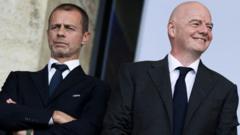
Infantino World Cup Boycott Crisis Unfolds
The global football landscape has shifted dramatically following UEFA's unprecedented stance regarding the Infantino World Cup boycott threat and Concacaf's decisive rejection of FIFA president Gianni Infantino's proposed funding framework. This escalating confrontation represents one of the most significant governance challenges in modern football, raising critical questions about Infantino's tenure and the future direction of international competition.
Understanding the Current Conflict
Over the past 48 hours, European football's governing body has signaled its willingness to withdraw from the World Cup—a position that would have been unthinkable mere weeks ago. Simultaneously, the Confederation of North, Central America and Caribbean Association Football (Concacaf) formally rejected Infantino's financial proposal, creating a unified front of opposition against FIFA's leadership structure. This dual rejection suggests deep-seated concerns about resource allocation and decision-making authority within international football governance.
The Funding Plan at the Center of Controversy
What Infantino Proposed
The FIFA president's funding initiative was designed to redistribute resources across confederations, theoretically ensuring more equitable financial distribution throughout international football. However, the plan evidently failed to satisfy the financial expectations and operational requirements of both UEFA and Concacaf, two of FIFA's most influential regional bodies. The rejection indicates fundamental disagreements about transparency, accountability, and the methodology for allocating World Cup-generated revenues.
Reasons for Rejection
UEFA's resistance to the Infantino funding model appears rooted in concerns about maintaining Europe's competitive advantage and financial security. Concacaf's position reflects different regional priorities, suggesting the proposal did not adequately address member confederation needs. Both organizations view the current distribution framework as insufficient for their developmental and operational objectives.
UEFA's Unprecedented Stance
The threat of a World Cup boycott represents an extraordinary escalation in UEFA's dispute with FIFA administration. European nations represent approximately 50% of international football's commercial value and viewership, making any genuine withdrawal an existential threat to the tournament's viability and commercial success. This leverage explains why such threats carry weight in negotiations with FIFA leadership.
Infantino's Leadership Under Scrutiny
Beyond the funding dispute, this crisis exposes broader questions about Infantino's presidency. Since assuming office, he has pursued controversial policies including World Cup expansion proposals and restructuring of international competition formats. The unified opposition from major confederations suggests his governance model lacks sufficient consensus among football's power brokers. Questions about his continued viability as FIFA president have intensified considerably.
Immediate Implications for International Football
The standoff creates uncertainty surrounding World Cup logistics, participation commitments, and broadcast arrangements. If genuine negotiations fail and boycott threats materialize, the reputational damage to FIFA and the affected World Cup would be catastrophic. Media partners, sponsors, and participating nations would face extraordinary complications.
What Happens Next
Negotiation Scenarios
Most likely, intensive behind-the-scenes negotiations will produce a revised funding framework attempting to satisfy UEFA and Concacaf concerns. FIFA leadership may need to compromise significantly on the Infantino World Cup boycott prevention, potentially requiring structural concessions regarding decision-making authority and revenue distribution methodology. Such negotiations typically move quickly when World Cup participation hangs in balance.
Leadership Questions
If this crisis deepens without resolution, pressure for Infantino's removal could intensify. FIFA's member confederations possess the authority to challenge his presidency, and coordinated action from UEFA and Concacaf could prove decisive. However, Infantino retains support from several confederations, meaning any removal effort would require substantial coalition-building.
Broader Governance Reform
This conflict may catalyze fundamental discussions about FIFA's decision-making processes, financial transparency, and confederation representation. European football's organized response demonstrates that international governance structures require greater consensus-building and stakeholder engagement than Infantino's presidency has historically provided.
The Bigger Picture
The Infantino World Cup boycott crisis transcends immediate financial disputes, reflecting deeper structural tensions within international football governance. Confederations increasingly demand meaningful participation in strategic decisions affecting their regions and financial interests. This represents a fundamental challenge to centralized FIFA authority that extends beyond one president's tenure.
Conclusion
The next weeks will prove decisive for Infantino's presidency and FIFA's organizational structure. Whether through compromise or confrontation, this crisis will reshape international football governance significantly. The unified position of UEFA and Concacaf demonstrates that modern football administration requires collaborative leadership and stakeholder respect—qualities that may ultimately determine Infantino's political survival and FIFA's institutional credibility.


