Historic Solar Eclipse Captivates Millions Across UK and Europe
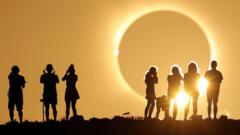
Once-in-a-Generation Solar Eclipse Mesmerizes Millions
A remarkable solar eclipse UK Europe event captured the attention and imagination of millions of people across multiple continents, marking one of the most significant astronomical occurrences of our time. The celestial phenomenon unfolded across the British Isles and continental Europe, delivering an unforgettable experience for observers positioned along the eclipse path. This solar eclipse UK Europe spectacle demonstrated nature's grandeur on an unprecedented scale, with enthusiasts traveling considerable distances to witness the cosmic dance between the Moon and the Sun.
Exceptional Coverage in Cornwall
The southwestern English county of Cornwall experienced extraordinary solar coverage as the Moon positioned itself directly in front of the Sun. More than 95% of the solar disc was obscured by the Moon's shadow, creating a twilight effect during what should have been midday hours. This near-total coverage transformed the landscape into an ethereal setting, with temperatures dropping noticeably and the quality of daylight shifting to a surreal, dimmed state. Observers in Cornwall reported that the experience came remarkably close to witnessing a complete eclipse, with only a sliver of the Sun remaining visible during the moment of maximum eclipse.
Atmospheric Changes During Peak Eclipse
Witnesses throughout Cornwall documented profound environmental changes as the eclipse reached its apex. The reduction in solar radiation created palpable cooling effects that were felt across the region. Wildlife behavior shifted notably, with birds exhibiting confused responses to the sudden darkness at midday. The scientific community seized this opportunity to conduct measurements and observations that contribute to our understanding of solar physics and atmospheric interactions during eclipse events.
Spain Experiences Totality
Further south on the Iberian Peninsula, regions of Spain achieved the complete eclipse phenomenon, experiencing totality as the Moon fully covered the Sun's disc. This dramatic moment lasted several minutes in favorable locations, during which observers witnessed the Sun's ethereal corona—a sight visible only during total solar eclipses. The total eclipse in Spain represented the culmination of the astronomical event's path, where the Moon's umbral shadow created conditions for experiencing the complete disappearance of the Sun's bright surface.
Scientific Observations During Spanish Totality
Astronomers and researchers positioned throughout Spain conducted intensive observations and measurements during the period of totality. These moments provide invaluable data regarding solar atmospheric properties, magnetic field behavior, and coronal heating mechanisms. The total eclipse enabled scientists to deploy specialized equipment and conduct studies that would otherwise be impossible, advancing our comprehension of the Sun's complex outer atmosphere.
Widespread Impact Across Europe
The astronomical event generated significant interest throughout Europe, with numerous countries along the eclipse path experiencing partial to near-total coverage. Viewing events organized by scientific institutions, planetariums, and amateur astronomy clubs drew substantial crowds seeking to participate in this rare celestial occurrence. Public engagement with the eclipse reflected humanity's enduring fascination with astronomical phenomena and the shared experience of witnessing cosmic events that unite observers across geographical and cultural boundaries.
Historical Significance of the Event
The classification of this eclipse as a once-in-a-generation event underscores its relative rarity and exceptional characteristics. Depending on one's specific geographic location, such dramatic solar eclipses may occur only once or twice during a person's lifetime. This temporal spacing amplifies the significance of each eclipse event, creating powerful motivation for observers to travel and position themselves optimally for viewing. The historical rarity of total solar eclipses in densely populated European regions made this particular event especially notable for continental observers.
Preparation and Public Engagement
Months of preparation preceded the eclipse, with scientists, educators, and tourism organizations coordinating efforts to facilitate widespread observation. Safety campaigns emphasized proper eye protection using certified eclipse glasses, ensuring that the millions viewing the event could do so without risking retinal damage. Educational institutions incorporated eclipse-related content into curricula, helping students appreciate both the scientific mechanisms underlying eclipses and their cultural significance throughout history. Public enthusiasm manifested in travel patterns, with transportation networks experiencing increased demand as people repositioned themselves to optimal viewing locations.
Meteorological Factors and Viewing Success
Weather conditions proved favorable across much of the eclipse path, particularly in Cornwall and Spain, where cloud cover remained minimal during the critical viewing windows. This fortunate meteorological situation enabled the vast majority of observers to witness the event with minimal atmospheric obstruction. Weather services across Europe had monitored atmospheric conditions extensively in the days leading to the eclipse, providing forecasts that helped observers select optimal viewing locations based on predicted cloud patterns.
Legacy and Future Astronomical Events
The successful observation of this once-in-a-generation eclipse by millions of people across the UK and Europe will remain a memorable milestone in the collective experience of European observers. The data collected by scientists during this event will contribute to our expanding knowledge of solar phenomena for decades to come. As future eclipses are charted and predicted, the memories and experiences from this remarkable celestial event will inspire continued interest in astronomy and the study of our dynamic solar system.


